There are Yoga untold spiritual truths. Yoga is a spiritual discipline more than a physical discipline.
What is Yoga
Yoga is a generic term for a physical, mental and spiritual discipline originating in ancient India and found in Hinduism, Buddhism, Jainism and Sikhism.
It has a literal meaning of ‘Yoke’ from a root ‘yuj’ meaning ‘to join’, ‘to unite’ or ‘to attach’.
In Hindu, the word refers to one of the six doctrine schools of Hindu philosophy. Thus yoga is a spiritual discipline more than a physical discipline.
Origin of Yoga
Although Yoga is said to be as old as civilization, there is no physical evidence to support this claim.
No one knows exactly the source of Yoga and everyone will tell you that it dated back way before 5,000 years but with no evidence.
The earliest archaeological evidence of Yoga’s existence comes from stone seals which depict figures of Yoga Poses. They say that stone seals place Yoga’s existence around 3000 B.C.
Purpose of Yoga
Yoga is the method of yoking or unifying the ‘lower’ (egoistic) personality to the ‘higher’ via a pr.
Through this they claim it brings the body, soul and spirit in unison.
Is Yoga just an Exercise?
Many people today are taking yoga techniques for physical exercise and most of them do not know what yoga is.
They believe that there is nothing wrong with implementing this form of exercise into their daily regiment for a healthy body.
However, the practice of yoga is much more than a system of physical exercise for health. No one can deny that it involves physical, mental and spiritual discipline but many people are fallacious claiming that it has no spiritual incline.
Yoga is an ancient path to spiritual growth and originates out of India where Hinduism is practiced.
The techniques of Yoga are practiced by the Indus to initiate spiritual growth.
The yogis encourage union with the finite ‘jiva’ (transitory self) and with the infinite ‘Brahman’ (eternal self). Brahman is a term used by the Hindus to mean ‘God.’
Yogis usually think of God as an impersonal, spiritual substance, coexisting with all of reality.
Yoga techniques for exercising cannot be separated from its philosophy. It is a practice of psychosomatic exercises.
The yoga scholar will tell you that in order to practice yoga in the fullest, one must experience what is called the ‘kundalini’ effect within meditation. What does this mean?
For spiritual lessons to be grasped by the soul within the person, the chakra or different locations within the body where a circle of metaphysical and/or biophysical energy resides join together in the process.
‘Kundilini’ stimulates the chakra center to open and release the energy held within. If not done properly, some believe that a person can injure the brain.
Spiritual meaning of Yoga positions
Many yoga postures are named after things found in nature. Animal-named poses range from cobra, eagle to cat, including animals of several different families.
Let us look at some Yoga positions spiritually
1. Sun salutation
The Sun Salutation is often one of the first series of poses done directly after seated breathing exercises during morning yoga sessions.
The Salutation is meant to greet the sun and is used as a way to worship the Hindu sun god, Surya, who us the symbol of health and immortal life.
The 12 distinct poses of the Sun Salutation each have their own mantra and the series is meant to celebrate the sun and the sun-god.
2, Downward Facing Dog Pose
This sound funny at first but after you’ve watched a dog wake up and go into a deep stretch, the name of the pose takes on a new meaning.
The spiritual implication behind the pose lies in the act of a combined stretch with a moment in which the yogi turns inward simultaneously connecting to your center while stretching your body into a long line has a unifying effect positioning your spirit within while you stay connected to the outside world.
3. Tree Pose
The essence of Tree Pose is to find balance. However, balance is not found in this pose in a rigid manner such as one might associate with a balanced ballet position.
In Tree Pose, your body may sway like a tree does in the wind but your foot stays rooted into the ground. This gives the body freedom to move and find its balance while you envision being rooted in the ground developing your spiritual acceptance of your body’s position in space as claimed.
4. The lotus position
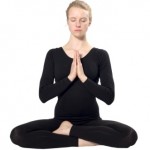
Lotus position is an exercise used in opening yourself up for the spirit to come in.
It is usually depicting a sexual act especially the way you sit crossing your legs with all your fingers touching the thumb. There comes something in the spiritual realm that is known as the diamond which is like a penis and it comes and enters you.
The lotus position forms a spiritual penis and it enters you and performs sexual acts with you. You cannot refuse it so it just comes and enters you.
5. Headstand Poses
Headstand poses are among the most difficult for yogis to achieve but they are also some of the most spiritually impacting poses.
Kundalini uses head stand poses to awake and uncoiled the serpent (Satan or snake) energy in the base of the spine bringing it to the crown of the head.
In a head stand pose, they claim, one can achieve an even mind, partial enlightenment and even fearlessness.
6. Animal Poses
There are a variety of animal poses in yoga named after the animals that they resemble.
For instance, a cat pose is done with an arched back while the cobra pose looks like a snake rearing its head.
The spiritual purpose of each animal pose is to allow you take or posses the attributes of that animal.
For instance, the eagle pose is claimed to bring you a clear mind’s eye and a lion’s pose can help you feel brave and in control.
7. Strength Poses
Certain poses are claimed to put you in a power stance and help you develop a greater appreciation for the natural world while helping you feel like a stronger individual.
The popular warriors pose is said to help you feel spiritually powerful while the tree pose is meant to make you feel calm, balanced and in control.
Seated poses, like the lotus poses, are meant to help you turn inward during guided and self meditation for a deeper state of enlightenment.
Yoga is spiritual and worship of other gods
- Yoga is spiritual and worship of other gods; it is idolatry.
- The doctrine of yoga is called pantheism which is the view that everything is God and man is God.
- Yoga teaches us to focus on ourselves instead of focusing on the one true God.
- It encourages us to seek the answers to life difficult questions within our own conscience instead of in the Bible.
- It also leaves one open to deception from Satan who searches for victims who he can turn away from God.
Yoga is more of a spiritual discipline than a physical discipline and these are the Yoga Untold Spiritual Truths.
Do not be deceived.
God bless